
Lauren Berns was browsing Talking Points Memo when he saw an ad with President
Obama’s face. “Stop the Reckless Spending,” the ad read, and in smaller print,
Paid for by Crossroads GPS.
Berns was surprised. Why was Crossroads GPS, a group that powerful Republican
strategist Karl Rove helped found,advertising
on a liberal-leaning political website?
Looking closely at the ad, Berns saw a small blue triangle in the upper-left
hand corner. He knew what that meant: this ad wasn’t being shown to every
person who read that page. It was being targeted to him in particular.
Tax-exempt groups like Crossroads GPS have become among the biggest players in
this year’s election. They’re often
called “dark money” groups, because they can raise accept
unlimited amounts of money and never have to disclose their donors.
These groups are spending massively on television spots attacking different
candidates. These ads are often highly publicized and get plenty of media
attention.
But these same dark
money groups are also quietly expanding their online advertising efforts, using
sophisticated targeting tactics to send their ads to specific kinds of people.
Who they’re targeting,
and what data they’re using, is secret.
Online advertising
companies have amassed vast quantities of information on what individual people
read, watch, and do on the Internet. They collect this data using small files
called cookies, which allows them to track Internet users as they move from
site to site.
These anonymous
profiles of information are used to customize advertisements—like sending
casino ads to someone who just bought a plane ticket to Vegas.
But these profiles
are also increasingly used by political groups, which can decide which people
to target with a message—and which people to avoid—based on the
kinds of articles they read and the kinds of sites they visit.
Many Internet users
who see these ads may not be aware they’re being targeted.
As we’ve detailed, both the Romney and Obama campaigns are using advanced tracking and targeting tactics.
Working with our readers, we found two examples of dark money groups using this
kind of targeting, as well: one ad from Crossroads GPS and one ad from Americans
for Prosperity, a nonprofit linked to the politically influential Koch
brothers.
How many of these ads
are dark money groups sending out? It’s hard to say, because it’s not easy to
track exactly how much Crossroads, Americans for Prosperity, and similar groups
are spending on different kinds of advertising.
But these politically
influential organizations are moving more of their efforts online.
While Crossroads
spokesman Jonathan Collegio said he couldn’t get into the specifics of their
budget, “Crossroads will certainly spend more in the online space in 2012 than
it did in 2010,” he said.
Americans for
Prosperity did not return multiple requests for comment.
Even when Internet
users are sophisticated enough to spot a targeted ad, as Lauren Berns did,
it is almost impossible for them to find out why a certain organization is
targeting them—or what data about them is being used.
Berns, for instance, is
a registered independent from St. Petersburg, Florida—exactly the kind of
voter whose opinion campaigns and political groups are trying to sway before
November. He’s a self-described “news junkie,” who reads both liberal and
conservative news sites and posts articles to Facebook two to ten times a day.
But it wasn’t clear what part of his Internet behavior ad triggered the
Crossroads ad—or whether information about his offline life was part of
the targeting formula.
Had he been shown the Crossroads ad because he had visited Mitt Romney’s site? Because he regularly reads the conservative sites of The Daily
Caller and The Weekly Standard? Because he lives in a
swing state?
Did Berns fit the profile of a potential Crossroads supporter because he’s a
44-year-old who travels regularly? Or because he shares things with his
friends, thus making him a potential “social influencer?”
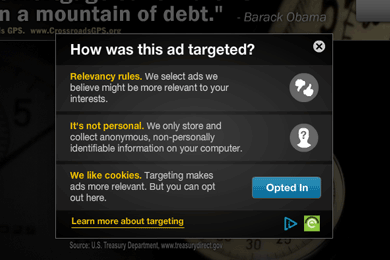
A popup message
accompanying the ad offered information about the targeting. But it only explained,
“We select ads we believe might be more relevant to your interests.”

The popup in the ad Berns received.
When we sent Crossroad’s Collegio a copy of the ad, he said he could not
explain exactly how the ad had been targeted, saying, “it’s a matter of
strategy that we would hold close to our chests.”
But he did offer one
potential targeting factor. “We are looking for viewers who are more likely to
engage their lawmakers in an issue advocacy campaign, and those are generally
viewers who visit news and current affairs websites,” Collegio said.
If Crossroads GPS was looking to target news junkies, then Berns was the kind
of person they were trying to reach—although, of course, that didn’t necessarily mean
he was sympathetic to the ad’s message.
Berns regularly reads conservative sites and says he is skeptical of both
parties, but on policy issues, he says, he lines up more closely with the
Democrats.
Because Crossroads
wouldn’t disclose their targeting strategy, we can’t know how many other
factors may have been involved. Collegio would not say whether the online ad
was only sent to viewers in certain states.
Television ads from dark
money groups often get significant media scrutiny. When Crossroads GPS launched a television
ad in early June attacking President Obama’s “reckless spending,” the group’s
$7 million ad buy made headlines in papers across the country. The Washington Post fact-checked the ad’s claims, and concluded that the ad contained both
exaggerations and omissions.
What didn’t get
mentioned, by newspapers or by Crossroads’ own press
release, was that an online
version of the same ad—the ad Berns saw—would appear on the
computer screens of select individuals, based on their Internet habits.
Collegio said it was “likely an oversight” that the Crossroads press release
didn’t include a description of the online part of the ad campaign.
But, he noted, “When we announce online buys, the media rarely report on it.”
By their nature,
targeted online ads are harder for news organizations to track, since they are
only shown to some users, and will never appear to others.
This makes targeted
ads much less transparent than TV ads, and makes it harder to tell if
politicians or political groups are using targeting to pander to certain groups
of voters, or whether they’re sending out ads that are misleading,
hypocritical, or just plain false.
As part of our
campaign coverage, we’ve been asking readers to send in screenshots of any
targeted political ads they see. Berns
was one of the first to send in screenshots of a targeted ad.
Another targeted dark
money ad came from a woman in Wisconsin, who asked that her name not be used.
She sent screenshots of a targeted ad from the Koch-linked Americans for
Prosperity attacking Wisconsin Democratic congresswoman Tammy Baldwin, who is
now running for Senate.

The Americans for Prosperity ad on the Washington Post’s site.
The ad, which reads, “Tell Tammy Baldwin: Wisconsin can’t afford Washington’s
wasteful spending!” asks viewers to “Click here to sign the petition.”
The ad appeared on multiple sites the woman visited, including in a prominent
place on the home page of the Washington Post.
While Americans for Prosperity did not return requests for comment, a Washington
Post spokeswoman said a broader Americans for Prosperity ad campaign had been taken
down because it had not been approved by the Post’s advertising team.
While many critics of targeting have been concerned that political groups might
use targeting to send out controversial ads without attracting attention, that
wasn’t the case with the two ads our readers spotted. The targeted ads from
both groups sent the same message as their spots shown on TV.
Recent surveys
suggest many American aren’t enthusiastic about political targeting online.
A survey of 1,503 adult
Internet users released
this week by the Annenberg School for Communications found that 86 percent of
the respondents did not want “web sites to show you political ads tailored to
your interests.” Most respondents also said they want to know what the
campaigns know about them.
In general, Berns said, “I’m fine with targeted advertising. If I’m going
to see ads on the Internet, I’d rather they be something I’m interested in.” But, he said, he draws the line at
politics.
“I’d much prefer a world where candidates
tried to equally hard to reach everyone, present their policies rationally, and
let the chips fall where they may,” he wrote in an e-mail.
“Targeting by political viewpoint is ‘creepy,’” he wrote. “A little too
close to propaganda techniques for my comfort.”
Have you seen a targeted
political ad?
Help us find out how politicians are targeting you online.
- If you spot a small blue triangle icon on any online
political ad, or the words “Ad Choices,” take a screenshot of the ad. - Then click on the blue triangle or the words “Ad Choices” to find out
which company showed you the ad. Take a screenshot of that, too. - E-mail
the screenshots to us at [email protected]. Please include the full URL of the page where you saw the
ad.
If the ad asks you to “learn more,” visit a
website, donate, or sign a petition, please send us a screenshot of that site or
petition, as well. (The page where the ad sends you may also be targeted to
what advertisers know about you.)
Not sure
how to take a screenshot? Here are the instructions if you’re using a PC, using a Mac, or using a smartphone.
You can
also check out our “Message Machine” project, which analyzes how campaigns are targeting
voters with different e-mail messages.