
When the
team of patient safety experts volunteering for the National Quality Forum met
in 2009, it was no exaggeration to say lives were on the line. The dozen
committee members were updating “safe practice” guidelines that are taken
as gospel by the nation’s hospitals, where mistakes and preventable
complications cause
hundreds of thousands of patient deaths a year.
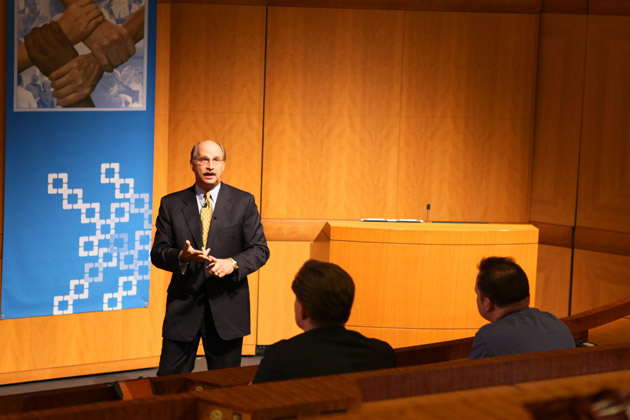
Dr. Chuck
Denham, one of the country’s most visible advocates for patient safety,
co-chaired the session. Denham resembles a trim version of Dr. Phil but talks
faster, lacing his speech with a mix of self-help and business jargon. Though
he lacked the deep research credentials of some others on the panel, Denham had
more than made up for it with evangelistic zeal, including a featured role in a
patient safety documentary with the actor Dennis Quaid.
A transcript
of the meeting shows that when discussion turned to preventing hospital
infections, Denham twice brought up a study that endorsed a particular formula for antiseptic skin
cleansers. What the committee didn’t know: A business run by Denham had
contracts worth $11.6 million from a company whose market-leading product, ChloraPrep, used that
same formula.
Earlier this
month, the U.S. Justice Department settled a $40 million whistleblower lawsuit with CareFusion, the maker of ChloraPrep. The case claimed the money paid to Denham’s business was a kickback to get him to manipulate the National Quality Forum’s standards and boost sales of the drug.
Denham
has called the allegation “blatantly false.” But the case has shaken the
patient safety world, prompting speculation about a star figure’s motives and
questions about the inner workings of the Quality Forum, whose guidelines are
regarded as the gold standard for best health care practices.
The Quality Forum has said it halted dealings with Denham in 2010 and took steps to insulate its guidelines from commercial influence. Officials from the
organization said they were confident that none of the guidelines was corrupted
to favor the company that was paying Denham.
But two high-profile
members of the committee told ProPublica they believe the process was compromised,
resulting in an unintended endorsement of ChloraPrep.
And a review by ProPublica found that the group’s final 2010 guidelines,
currently in effect, still recommend the ChloraPrep
formula.
Asked about the discrepancy last week, the Quality Forum said it was
launching a new review of all the recommendations listed in its 2010 “Safe
Practices for Better Healthcare” report.
Also in
response to questions from ProPublica, the Quality Forum divulged that Denham’s
nonprofit was one of its contributors, and that in 2007 and 2008 it received
$485,000 in donations from a foundation affiliated with Cardinal Health, a
company that spun off CareFusion in 2009.
The committee members who
spoke to ProPublica said they were surprised to see the formulation specific to
ChloraPrep in the 2010 guidelines. The transcript of
the committee’s discussion in 2009 shows that Denham suggested the panel
endorse the formula, but no final agreement to recommend it.
Dr.
Patrick Romano, a professor and researcher at the University of California, Davis
School of Medicine, said the recommendation “is likely to reflect improper
commercial influence.”
Both Romano and Dr. Peter Pronovost, who leads a patient safety institute at Johns
Hopkins Medicine, said they had been unaware of Denham’s financial ties with CareFusion. Quality Forum officials said Denham never
reported them, nor did he mention them during the 2009 meeting when members were asked to
disclose their financial relationships, the transcript shows.
“He clearly lied,” Dr. Christine Cassel, the Quality Forum’s president and CEO told
ProPublica. “He just didn’t say anything about any of his business
relationships.”
Cashing In On Patient Safety
As the
medical community comes to grips with the persistent problem of patient harm,
companies are selling solutions. Although many groups recommend best practices,
an endorsement by the Quality Forum can mean riches.
Created in 1999 at the behest of a presidential commission, the Washington, D.C.-based nonprofit takes private donations and
collects fees from members, including consumer groups, health plans and medical
providers.
Five years ago, the federal government hired the Quality Forum to endorse measures
to show whether health care spending is achieving value for patients and
taxpayers. The contract has since grown substantially and by 2012 made up
nearly three-fourths of the organization’s $26 million in revenue.
The Quality Forum’s standards are widely adopted. The report produced by the
committee Denham co-chaired included recommendations for best practices in 34
areas of care.
Denham is
not a practicing doctor. He runs both the Texas Medical Institute of
Technology, an Austin nonprofit that focuses on patient safety research, and a
for-profit company called Health Care Concepts that figured in the whistleblower
case. He’s known in patient safety circles for his fervent motivational
speaking and appearances with Quaid, whose infant twins nearly died from a
medication error.
Between
2006 and 2009, Denham’s nonprofit donated $725,000 to the Quality Forum. The
group and Denham had a five-year contract, but the Quality Forum declined to
provide a copy or explain the terms, saying only that it
was ended three years early, in 2010, after
concerns about Denham emerged.
In
a response to questions from ProPublica, Denham attorney Larry Gondelman said the Quality Forum signed off on all the
recommendations that appeared in the final 2010 Safe Practices report.
According to Gondelman,
Denham’s nonprofit was obligated to provide financial and staff support for
Quality Forum projects, including evidence-based medicine reviews, hosting
webinars and creating multimedia presentations about the safe practice
recommendations.
Denham
declined an interview request. He said in a separate statement that the $11.6 million came via two
contracts in 2008 with Cardinal Health to develop performance models and
software to help reduce infections. CareFusion was a
subsidiary of Cardinal Health at the time.
The 2010
film with Quaid, “Chasing
Zero,” was made and promoted by Denham’s nonprofit and partially funded by CareFusion. The film features interviews with prominent
patient safety experts, including Janet Corrigan, former chief executive
officer at the Quality Forum.
ChloraPrep is not named in the film, but in one scene it is
being applied while an expert talks about its ability to prevent surgical-site
infections. According
to Denham’s website, a copy of “Chasing Zero” was to be sent to every
hospital in the country.
CareFusion officials declined to comment for this story. The Justice Department case, filed in U.S. District Court in Kansas, accused CareFusion for marketing ChloraPrep for off-label uses. Documents in the case describe the antiseptic as the No. 1 drug in its class in 2010 with sales of $193 million. The government alleged that the money paid to Denham’s company was part of an effort to boost sales and included financing in a study published in the New England Journal of Medicine.
The
January 2010 study, whose authors all reported ties to Cardinal Health, found
that ChloraPrep — a combination of 2 percent chlorhexidinegluconate with
isopropyl alcohol — reduced the risk of surgical site infection by 41
percent compared to a common alternative.
Company
promotional materials went on to portray the finding as a 41 percent reduction in infections, and a 41
percent reduction in costs, the Justice Department said in court papers.
The 2 Percent Solution
At the
safe practices committee session on Aug. 19, 2009, Denham twice appears to
reference the New England Journal of Medicine study, the meeting transcript
shows. Although he did not cite the study or ChloraPrep
by name, Denham remarked that research to be published soon in a “major
journal” would show the effectiveness of the 2 percent chlorhexidine
antiseptic.
Pronovost said it wasn’t necessary to actually identify ChloraPrep because it was well known as the product with
the 2 percent chlorhexidine formulation.
The committee members agreed that chlorhexidine was an effective antiseptic –
guidelines by the Centers for Disease Control and Prevention (CDC) say so as
well. But studies show it also works in other concentrations and combinations.
Discussion turned to recommendations for preventing infections caused by
central lines, the thin tubes inserted into a vein to deliver fluids or
medications. Dr. Gregg Meyer of Massachusetts General Hospital in Boston, the
co-chair of the committee with Denham, brought up the forthcoming study.
“Chuck
(Denham) made me aware of it,” Meyer said. He then asked Pronovost,
a leading expert on preventing central-line infections, what he thought.
“There
has been a systematic review in a number of studies that show chlorhexidine reduces risk by about half,” Pronovost said.
Denham replied
that the upcoming study showed a 40 or 50 percent reduction. “The specifics,”
he added, “were the 2 percent.”
Pronovost noted that studies have shown other methods also
reduce infection rates. “My own recommendation would be to follow the CDC
guidelines,” he said.
The 2002 CDC guidelines said a 2 percent chlorhexidine
antiseptic is preferred, but that other skin cleansers, such as iodine, can
also be used. Newer 2011 CDC guidelines recommend an antiseptic with greater than 0.5 percent chlorhexidine combined with alcohol.
The committee never delved into the merits of the ChloraPrep
study or whether one particular concentration of chlorhexidine
was better than another, the transcript shows.
In
interviews, Pronovost and Romano both said they were
uncomfortable with the way the Quality Forum’s panel operated. The process
wasn’t as scientifically rigorous as it should have been, they said, and it was
hurried, without enough time to carefully review all the evidence.
The transcript
shows the committee moving through dozens of complex topics, from improving
hand hygiene and decreasing wrong-site surgery, to safety culture, pediatric
imaging and infections.
Pronovost said he complained to the Quality Forum about the
process and questioned at the time whether he should continue to participate.
“The NQF has a big voice and a lot of credibility,” Pronovost
said. “I wanted to make sure that whatever we recommended would truly be
beneficial and wise because it would change practice in America —
hospitals would do it. I felt we lacked a formal process for revising and
grading the evidence of recommendations for these safe practices.”
Ultimately, he decided not to leave the committee because he believed in
the Quality Forum and wanted to influence the process, he said. Something might
be put into place that doesn’t save lives, he said, or something might be
recommended that doesn’t help but uses tremendous resources.
“When
you’re doing these things you have to be extremely mindful,” he said.
The
committee members were volunteers, Romano said, and some felt burdened with the
responsibility of reviewing so much material without the help of the Quality
Forum staff. Romano said staffers from Denham’s Texas Medical Institute of
Technology performed the committee’s administrative functions, selecting the
studies to review and drafting the versions of the guidelines.
“It
was all a bit of a mystery to us that Chuck Denham was so generous with his
time and his staff time to support this process,” Romano said.
A Competitor Objects
After the meeting, when the committee’s draft report was published in
late 2009, a recommendation for preparing surgical sites to prevent infection
did not name ChloraPrep but did specify its telltale
formula – a 2 percent chlorhexadine and alcohol
antiseptic.
That
draft recommendation was challenged by 3M, a company that makes a competing
product. A scientific review of the evidence by a Quality Forum ad hoc
committee found a lack of clear evidence to support one skin prep product over another. As a
result, the recommendation to use the ChloraPrep
formulation on surgical sites didn’t make it into the final 2010 safe practices
report.
On the
separate issue of reducing central-line infections, the 2009 draft report
endorsed a chlorhexidine antiseptic but did not specify any one
concentration – just as the committee decided. Yet the final 2010 report
does call for a 2 percent chlorhexidine and alcohol antiseptic like
ChloraPrep.
Although
Quality Forum officials seemed surprised to learn this last week from
ProPublica, the group is listed
as a co-host, with Denham’s nonprofit, of a webinar where the 2010 safe
practices guidelines for central-line and surgical site infections are
presented.
The presentation, posted
on the website of Denham’s nonprofit, states that the Quality Forum
recommends the ChloraPrep formulation to protect
against both central-line and surgical site infections.
CareFusion also cites the Quality Forum’s endorsementin at
least one brochure
on its website.
Since the
financial ties between CareFusion and Denham’s
business became public, the Quality Forum heard from “a wide range of people in
the community,” spokeswoman Ann Greiner said. That feedback led to the decision
to review the entire safe practices process over the next 30 days, she said.
“We’re taking a very affirmative action
here,” Greiner said.
Pronovost said
the controversy over Dehnam should not call into
question all of the Quality Forum’s work. He said the lack of scientific rigor
of the safe practices committee reflected Denham’s influence, but the process
behind the Quality Forum’s other measures is more robust.
All the same, he said, it raises
significant concerns about oversight of the burgeoning quality improvement industry.
“It’s an enormous business,” Pronovost said. “Hundreds of millions or billions of
dollars are at stake, but our transparency procedures haven’t matured.”
Editor’s note: ProPublica is investigating
health care quality and welcomes your input. Medical providers – help us
by completing a brief Provider Questionnaire. Patients can complete ProPublica’s
Patient Harm Questionnaire.